
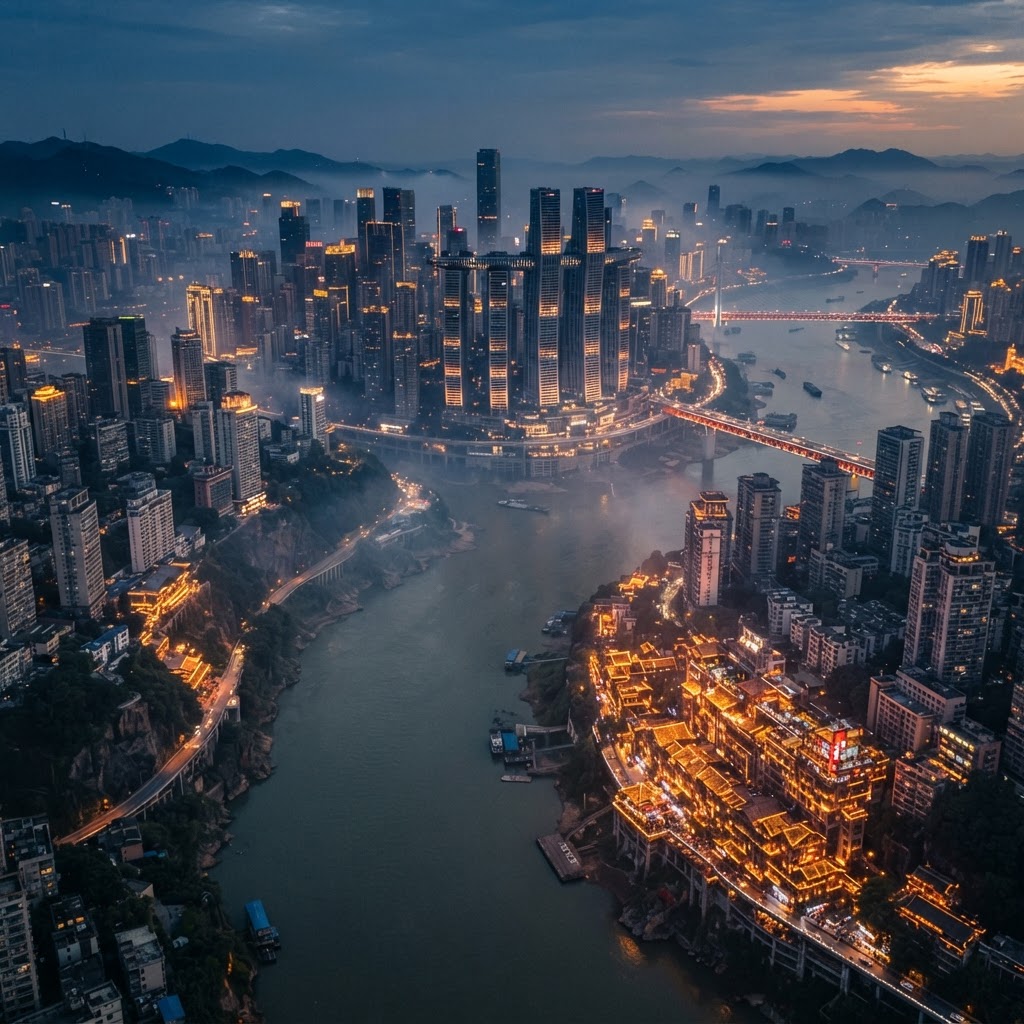
Chongqing
Chongqing is China's largest municipality by population — a 32-million-person mountain mega-city at the confluence of the Yangtze and Jialing rivers, famously built on steep hills with a futuristic skyline that has made it China's most photogenic 'cyberpunk' city. It is the economic engine of western China and a major auto, electronics and logistics hub. Chongqing University and Southwest University anchor its academic base. For students it offers dramatic scenery, fiery Sichuan-adjacent food, low costs and a distinctive, warm southwestern identity.
Why students choose Chongqing
Chongqing's student life is dramatic and social: hotpot with classmates on a mountainside, the Hongyadong stilt buildings lit at night, Liziba train-through-building, Ciqikou old town, Yangtze cable car rides, night cruises past the lit skyline, and a famously fiery local food scene. Chongqing University's campus sits in the central hills. The international community is growing but smaller than Chengdu's; the vibe is warm, loud and proudly local.
Career & jobs: Chongqing is western China's manufacturing and logistics leader — autos (Changan), electronics (BOE, Foxconn), motorcycles, chemicals and a booming cross-border e-commerce sector. Internships in manufacturing, supply chain, logistics and e-commerce are accessible. The city's lower costs and aggressive talent policies draw graduates; Chongqing University and Southwest University graduates are recruited across western China.
What you need to know about Chongqing
$420/mo
Chongqing is western China's manufacturing and logistics leader — autos (Changan), electronics (BOE, Foxconn), motorcycles, chemicals and a booming cross-border e-commerce sector. Internships in manufacturing, supply chain, logistics and e-commerce are accessible. The city's lower costs and aggressive talent policies draw graduates; Chongqing University and Southwest University graduates are recruited across western China.
Chongqing is safe and famously welcoming, with a hot-tempered but friendly local culture. Crime is low; the main practical hazards are the steep stairs and summer heat. Pedestrian caution is needed on the many elevated walkways. The city stays lively late, especially around Jiefangbei and Hongyadong.
Chongqing's metro is among the world's most dramatic — lines run through mountains, over rivers and even through a building at Liziba. It connects to Jiangbei International Airport and major high-speed-rail stations (Chengdu in 1.5 hours). The hilly terrain limits cycling; buses, monorail and ride-hailing dominate. Navigation can be confusing — a 'ground floor' may be the 22nd — but the transit system is extensive and cheap.
Chongqing hotpot is legendary — numbing-spicy beef tallow broth with offal, the city's signature dish. Beyond hotpot: Chongqing noodles (xiaomian), spicy chicken, grilled fish, and sour-spicy vermicelli. The food is hotter and oilier than Chengdu's, with a deep street-snack culture. Non-spicy options exist but are harder to find; the food culture is a genuine highlight and a challenge.
Hongyadong, Ciqikou Old Town, Liziba Train Station, Jiefangbei, Yangtze River Cableway, Three Gorges Museum, Dazu Rock Carvings (day trip)
Universities in Chongqing
No universities listed yet — ask an advisor for the full list.
Fund your studies in Chongqing
These scholarships apply to students heading to Chongqing. Check eligibility and apply early.
Guangdong Government Scholarship
Full tuition + stipend + insurance
PartialUniversityFudan University Scholarship
Full tuition + accommodation + stipend + insurance
Fully FundedEnterpriseTencent Scholarship
Partial tuition + internship stipend
PartialUniversityWuhan University Scholarship
Full tuition + accommodation + stipend + insurance
Fully FundedStudent visa for Chongqing
- X1 visa — long-term (degree programs, valid for the full study period)
- X2 visa — short-term (language and exchange programs up to 180 days)
- JW202 form from your university + admission notice required
- Convert to a residence permit within 30 days of arrival at the local Chongqing Entry-Exit Bureau
How to apply in Chongqing
- 1. Choose a university and program in Chongqing
- 2. Prepare documents (passport, transcripts, recommendation letters, study plan)
- 3. Submit the application and pay any application fee
- 4. Receive admission notice and JW202 form
- 5. Apply for your student visa at the Chinese embassy
- 6. Travel to Chongqing and register at your university
Applications for September intake usually close in June; spring intake closes in December.: Applications for September intake usually close in June; spring intake closes in December.
Most universities require a high school diploma (Bachelor), a relevant Bachelor (Master), language proficiency (HSK or IELTS), and a valid passport: Most universities require a high school diploma (Bachelor), a relevant Bachelor (Master), language proficiency (HSK or IELTS), and a valid passport.
Partner with us in Chongqing
Universities and agencies in Chongqing can partner with StudyInChina to recruit international students.