
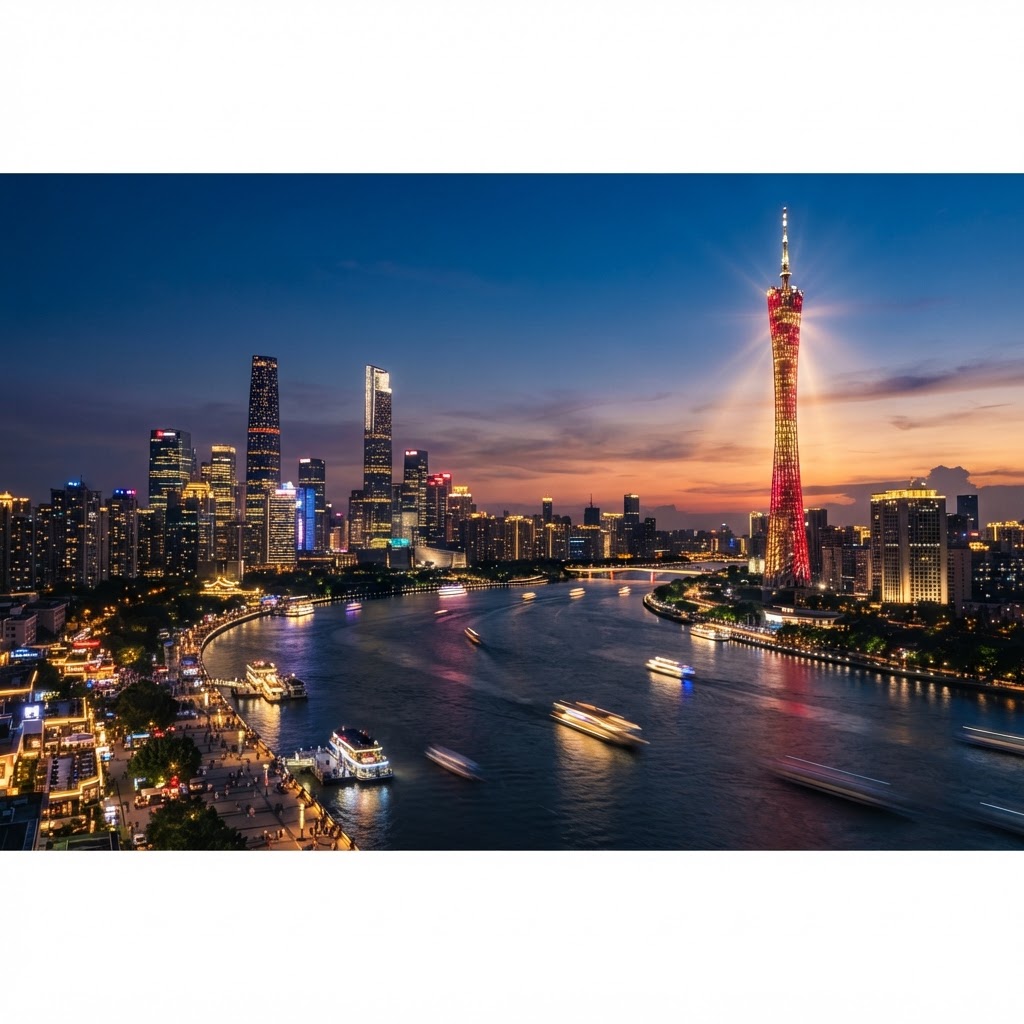
Guangzhou
A 2,200-year-old trading port and the historic gateway between China and the world, Guangzhou is the cultural heart of southern China and the capital of the Greater Bay Area's manufacturing belt. It hosts the Canton Fair, the oldest and largest trade expo in China, and a deep ecosystem of universities (Sun Yat-sen, SCUT, Jinan). For students it offers authentic Cantonese life, a warm climate, lower costs than Shanghai or Shenzhen, and unmatched access to international trade, manufacturing and logistics.
Why students choose Guangzhou
Guangzhou student life is rooted in food culture and trade energy: morning yum cha with classmates, evening strolls along the Pearl River, nightlife in Zhujiang New Town, bars around Beijing Road, hiking Baiyun Mountain, and weekend trips to the Canton Fair or nearby factory towns. Universities like Sun Yat-sen and SCUT have large international cohorts and active societies, and the city's southern pace feels less pressured than Beijing or Shanghai.
Career & jobs: As southern China's trade and manufacturing hub, Guangzhou excels in international trade, logistics, sourcing, e-commerce, fashion, and automotive and biotech internships (around the Pazhou and Nansha zones). The Canton Fair creates seasonal opportunities for translators and sourcing agents. English speakers do well in export-facing roles; Chinese speakers unlock supply-chain and operations work across the Greater Bay Area.
What you need to know about Guangzhou
$600/mo
As southern China's trade and manufacturing hub, Guangzhou excels in international trade, logistics, sourcing, e-commerce, fashion, and automotive and biotech internships (around the Pazhou and Nansha zones). The Canton Fair creates seasonal opportunities for translators and sourcing agents. English speakers do well in export-facing roles; Chinese speakers unlock supply-chain and operations work across the Greater Bay Area.
Guangzhou is very safe, with low violent crime and a relaxed southern lifestyle. As a major trade city, watch for inflated prices in tourist markets and pickpockets at the Canton Fair; otherwise the city is comfortable for international students moving about freely day and night.
Guangzhou's metro is one of China's largest, with 16+ lines reaching into Foshan and beyond, complemented by an extensive bus and BRT network. High-speed rail links to Shenzhen (30 min), Hong Kong (1 h) and Wuhan (4 h). Baiyun International Airport is a major hub for Southeast Asia. Ride-hailing and shared bikes are ubiquitous, and the city is navigable with limited Mandarin thanks to strong Cantonese-English signage in central districts.
The spiritual home of Cantonese cuisine: dim sum, white-cut chicken, char siu, wonton noodles, roast meats, congee and fresh seafood. Guangzhou is also famous for morning tea culture, late-night sweet soup (tong sui), and street snacks along Beijing Road. International dining is strong, especially Southeast Asian and halal, reflecting the city's trading ties.
Canton Tower, Shamian Island, Chen Clan Academy, Sacred Heart Cathedral, Baiyun Mountain, Pearl River cruise, Yuexiu Park
Universities in Guangzhou
Fund your studies in Guangzhou
These scholarships apply to students heading to Guangzhou. Check eligibility and apply early.
Guangdong Government Scholarship
Full tuition + stipend + insurance
PartialUniversityFudan University Scholarship
Full tuition + accommodation + stipend + insurance
Fully FundedEnterpriseTencent Scholarship
Partial tuition + internship stipend
PartialUniversityWuhan University Scholarship
Full tuition + accommodation + stipend + insurance
Fully FundedStudent visa for Guangzhou
- X1 visa — long-term (degree programs, valid for the full study period)
- X2 visa — short-term (language and exchange programs up to 180 days)
- JW202 form from your university + admission notice required
- Convert to a residence permit within 30 days of arrival at the local Guangzhou Entry-Exit Bureau
How to apply in Guangzhou
- 1. Choose a university and program in Guangzhou
- 2. Prepare documents (passport, transcripts, recommendation letters, study plan)
- 3. Submit the application and pay any application fee
- 4. Receive admission notice and JW202 form
- 5. Apply for your student visa at the Chinese embassy
- 6. Travel to Guangzhou and register at your university
Applications for September intake usually close in June; spring intake closes in December.: Applications for September intake usually close in June; spring intake closes in December.
Most universities require a high school diploma (Bachelor), a relevant Bachelor (Master), language proficiency (HSK or IELTS), and a valid passport: Most universities require a high school diploma (Bachelor), a relevant Bachelor (Master), language proficiency (HSK or IELTS), and a valid passport.
Partner with us in Guangzhou
Universities and agencies in Guangzhou can partner with StudyInChina to recruit international students.