
Harbin
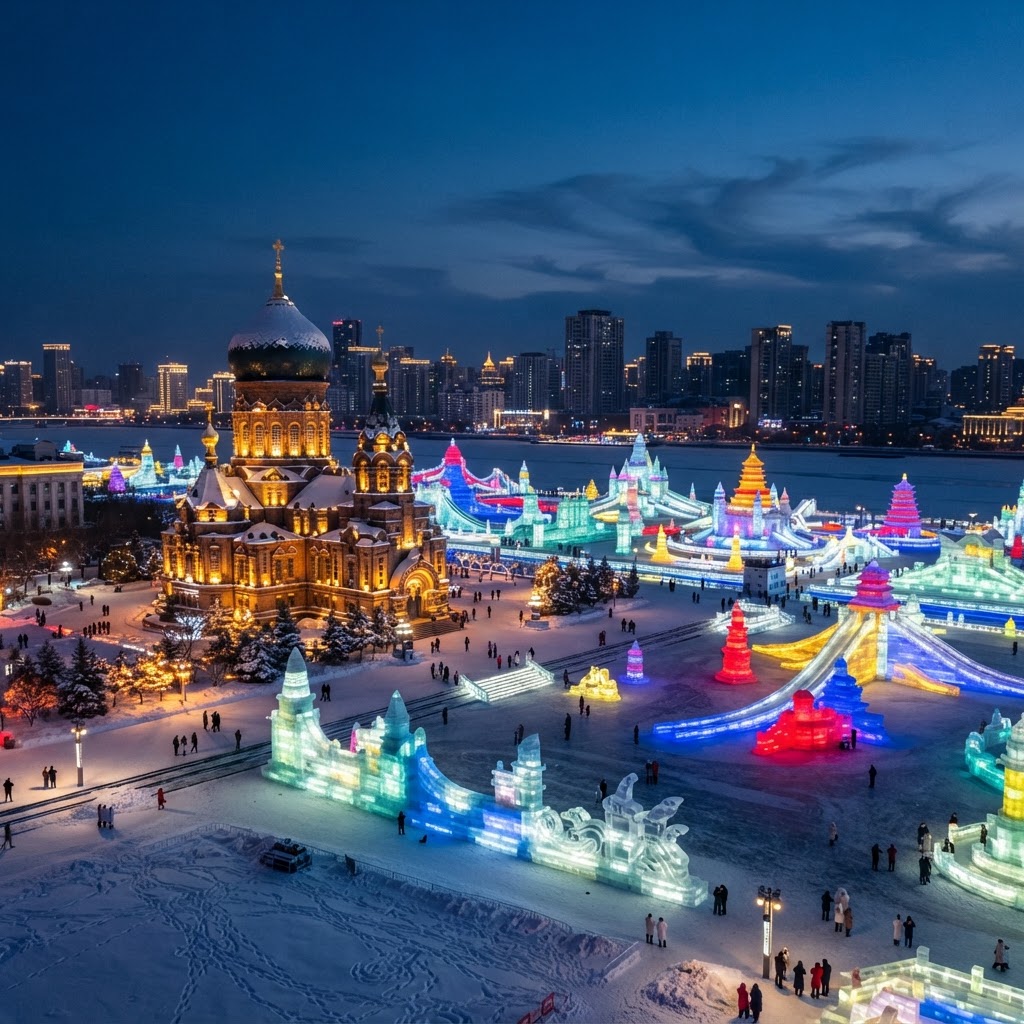
Harbin is the capital of Heilongjiang and China's most northerly major city — a Russian-influenced frontier metropolis on the Songhua River, famous for its January Ice and Snow Festival, Orthodox church spires and continental winters. It hosts the Harbin Institute of Technology (HIT), one of China's top engineering universities, and a strong aerospace and robotics research base. For students it offers a unique cold-weather culture, very low living costs, proximity to Russia and a distinctive northern identity unlike anywhere else in China.
Why students choose Harbin
Harbin student life is defined by winter magic and Russian heritage: the Ice and Snow World, Saint Sophia Cathedral, Central Street's European architecture, ice skating on the Songhua, Siberian tiger park visits, banya (Russian bathhouse) culture, and warm cheap northeastern dining. HIT's campus is historic and tight-knit; the international student community is smaller but friendly, and the low cost of living stretches student budgets far.
Career & jobs: Harbin is a national centre for aerospace, robotics, defence and heavy industry — HIT leads in robotics and astronautics research, with AVIC and aerospace institutes nearby. Internships skew to engineering and research. The local startup scene is smaller than coastal cities, but HIT graduates are recruited nationally into aerospace, defence and advanced manufacturing.
What you need to know about Harbin
$380/mo
Harbin is a national centre for aerospace, robotics, defence and heavy industry — HIT leads in robotics and astronautics research, with AVIC and aerospace institutes nearby. Internships skew to engineering and research. The local startup scene is smaller than coastal cities, but HIT graduates are recruited nationally into aerospace, defence and advanced manufacturing.
Harbin is very safe with low crime and a calm northern pace. The main practical concern is the extreme cold: temperatures can fall below −25 °C in January, so proper Arctic-grade clothing, insulated boots and caution on ice are essential. Frostbite risk is real for the unprepared; the city is well-equipped for winter but international students from warm climates must adapt.
Harbin's metro is smaller than coastal megacities but expanding, complemented by an extensive bus network. High-speed rail connects to Beijing in about 5 hours, and Taiping International Airport serves domestic and Russian routes. The frozen Songhua River becomes a winter transport-and-recreation corridor. Buses and ride-hailing handle the rest; winter cycling is limited by ice and cold.
Northeastern (Dongbei) cuisine is hearty and warming: guo bao rou (sweet-sour pork), stewed dishes, dumplings, pickled cabbage, smoked meats and Russian-influenced breads and sausages. Harbin's Russian heritage adds kvass, borscht-style soups and ice cream eaten outdoors in winter (a local tradition). Portions are large and prices low; the food is built for cold weather and big appetites.
Ice and Snow World, Saint Sophia Cathedral, Central Street, Siberian Tiger Park, Songhua River, Sun Island, Jile Temple
Universities in Harbin
Fund your studies in Harbin
These scholarships apply to students heading to Harbin. Check eligibility and apply early.
Guangdong Government Scholarship
Full tuition + stipend + insurance
PartialUniversityFudan University Scholarship
Full tuition + accommodation + stipend + insurance
Fully FundedUniversityZhejiang University Scholarship
Full tuition + monthly stipend + insurance
Fully FundedUniversityShanghai Jiao Tong University Scholarship
Partial to full tuition + stipend
PartialStudent visa for Harbin
- X1 visa — long-term (degree programs, valid for the full study period)
- X2 visa — short-term (language and exchange programs up to 180 days)
- JW202 form from your university + admission notice required
- Convert to a residence permit within 30 days of arrival at the local Harbin Entry-Exit Bureau
How to apply in Harbin
- 1. Choose a university and program in Harbin
- 2. Prepare documents (passport, transcripts, recommendation letters, study plan)
- 3. Submit the application and pay any application fee
- 4. Receive admission notice and JW202 form
- 5. Apply for your student visa at the Chinese embassy
- 6. Travel to Harbin and register at your university
Applications for September intake usually close in June; spring intake closes in December.: Applications for September intake usually close in June; spring intake closes in December.
Most universities require a high school diploma (Bachelor), a relevant Bachelor (Master), language proficiency (HSK or IELTS), and a valid passport: Most universities require a high school diploma (Bachelor), a relevant Bachelor (Master), language proficiency (HSK or IELTS), and a valid passport.
Partner with us in Harbin
Universities and agencies in Harbin can partner with StudyInChina to recruit international students.