
Nanjing
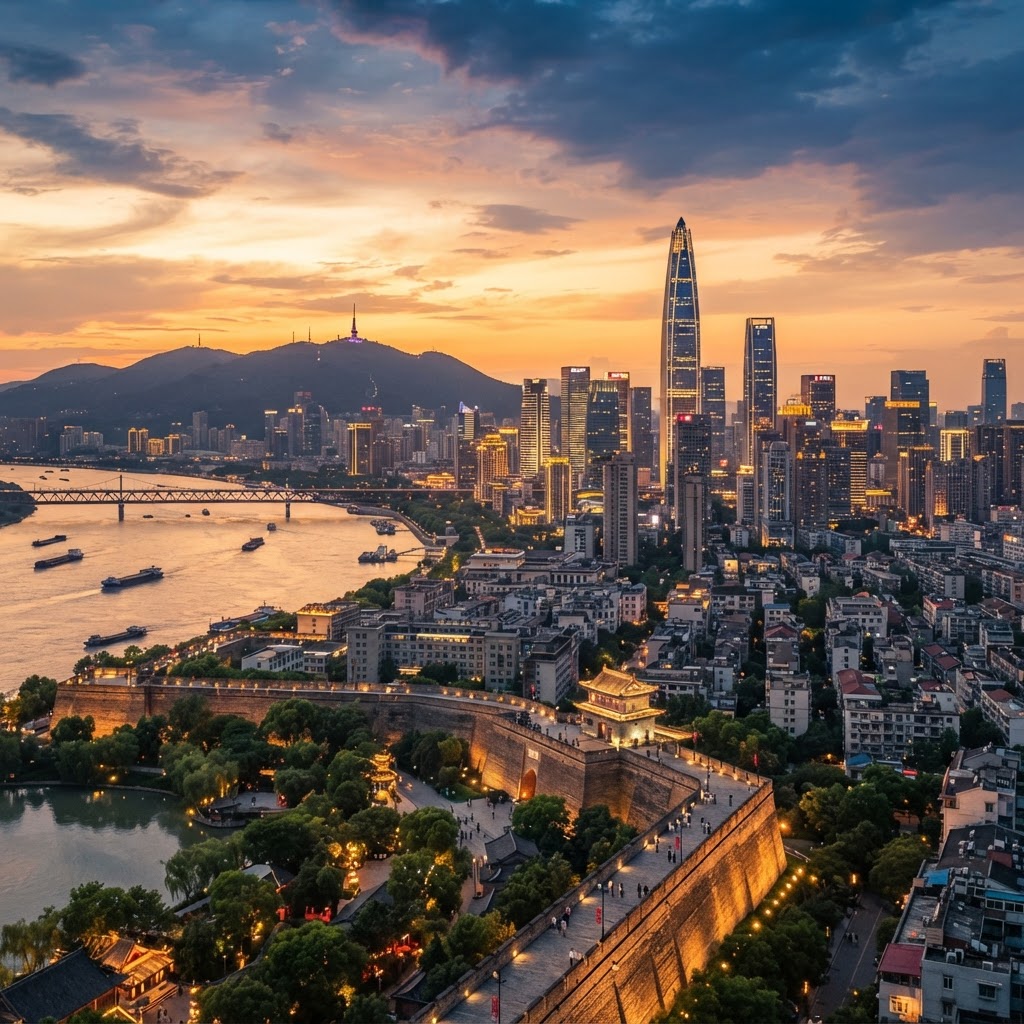
Nanjing — the 'Southern Capital' — was the seat of six ancient dynasties and the Republic of China, and today is one of China's leading education and research cities. Set on the Yangtze with Purple Mountain behind, it pairs tree-lined boulevards and Ming-era city walls with the campuses of Nanjing University, Southeast University and NJUPT. For students it offers a top-tier academic reputation, a deep history, a moderate cost of living, and a balanced, liveable pace between Shanghai's intensity and the inland capitals.
Why students choose Nanjing
Nanjing's student life is rich and historic: the Confucius Temple (Fuzimiao) district at night, Purple Mountain hiking, the Sun Yat-sen Mausoleum, Ming Xiaoling Tomb, the Yangtze riverside, and a dense cluster of campuses around Xianlin and Gulou. The city has a strong café and bookshop culture, lively student markets, and affordable entertainment. International communities are smaller than Shanghai but tightly knit and welcoming.
Career & jobs: As a major Jiangsu tech, electronics, automotive and pharmaceutical centre — home to LG, Foxconn, SAIC and many biotech firms — Nanjing offers strong internships in semiconductors, software, pharma and education. Its universities' reputation carries weight across the Yangtze Delta; graduates often split between Nanjing, Suzhou and Shanghai. English-teaching and EdTech roles are plentiful.
What you need to know about Nanjing
$450/mo
As a major Jiangsu tech, electronics, automotive and pharmaceutical centre — home to LG, Foxconn, SAIC and many biotech firms — Nanjing offers strong internships in semiconductors, software, pharma and education. Its universities' reputation carries weight across the Yangtze Delta; graduates often split between Nanjing, Suzhou and Shanghai. English-teaching and EdTech roles are plentiful.
Nanjing is calm and very safe. The city's university culture keeps neighborhoods orderly, and violent crime is rare. The main environmental note is summer heat — Nanjing is famously one of China's 'furnace cities' in July–August, so hydration, shade and air-conditioned study spaces matter.
Nanjing's metro is modern and extensive, crossing the Yangtze with several lines and reaching Lukou International Airport. High-speed rail puts Shanghai 1 hour and Beijing 3.5 hours away, and the city is a regional rail hub. Buses and shared bikes serve the leafy university district around Gulou and Xianlin, where most international students live and study. Student transit passes are cheap.
Nanjing cuisine is refined Jiangsu fare: salted duck, duck-blood vermicelli soup, pan-fried beef dumplings, lion's-head meatballs, and plum-blossom cakes. The city is famous for duck in every form, plus strong breakfast-snack culture at century-old shops. Cafés and international restaurants cluster around the university areas and Xinjiekou.
Sun Yat-sen Mausoleum, Ming Xiaoling Tomb, Confucius Temple, Purple Mountain, Nanjing City Wall, Presidential Palace, Qinhuai River
Universities in Nanjing
Fund your studies in Nanjing
These scholarships apply to students heading to Nanjing. Check eligibility and apply early.
Guangdong Government Scholarship
Full tuition + stipend + insurance
PartialUniversityFudan University Scholarship
Full tuition + accommodation + stipend + insurance
Fully FundedUniversityZhejiang University Scholarship
Full tuition + monthly stipend + insurance
Fully FundedUniversityShanghai Jiao Tong University Scholarship
Partial to full tuition + stipend
PartialStudent visa for Nanjing
- X1 visa — long-term (degree programs, valid for the full study period)
- X2 visa — short-term (language and exchange programs up to 180 days)
- JW202 form from your university + admission notice required
- Convert to a residence permit within 30 days of arrival at the local Nanjing Entry-Exit Bureau
How to apply in Nanjing
- 1. Choose a university and program in Nanjing
- 2. Prepare documents (passport, transcripts, recommendation letters, study plan)
- 3. Submit the application and pay any application fee
- 4. Receive admission notice and JW202 form
- 5. Apply for your student visa at the Chinese embassy
- 6. Travel to Nanjing and register at your university
Applications for September intake usually close in June; spring intake closes in December.: Applications for September intake usually close in June; spring intake closes in December.
Most universities require a high school diploma (Bachelor), a relevant Bachelor (Master), language proficiency (HSK or IELTS), and a valid passport: Most universities require a high school diploma (Bachelor), a relevant Bachelor (Master), language proficiency (HSK or IELTS), and a valid passport.
Partner with us in Nanjing
Universities and agencies in Nanjing can partner with StudyInChina to recruit international students.