
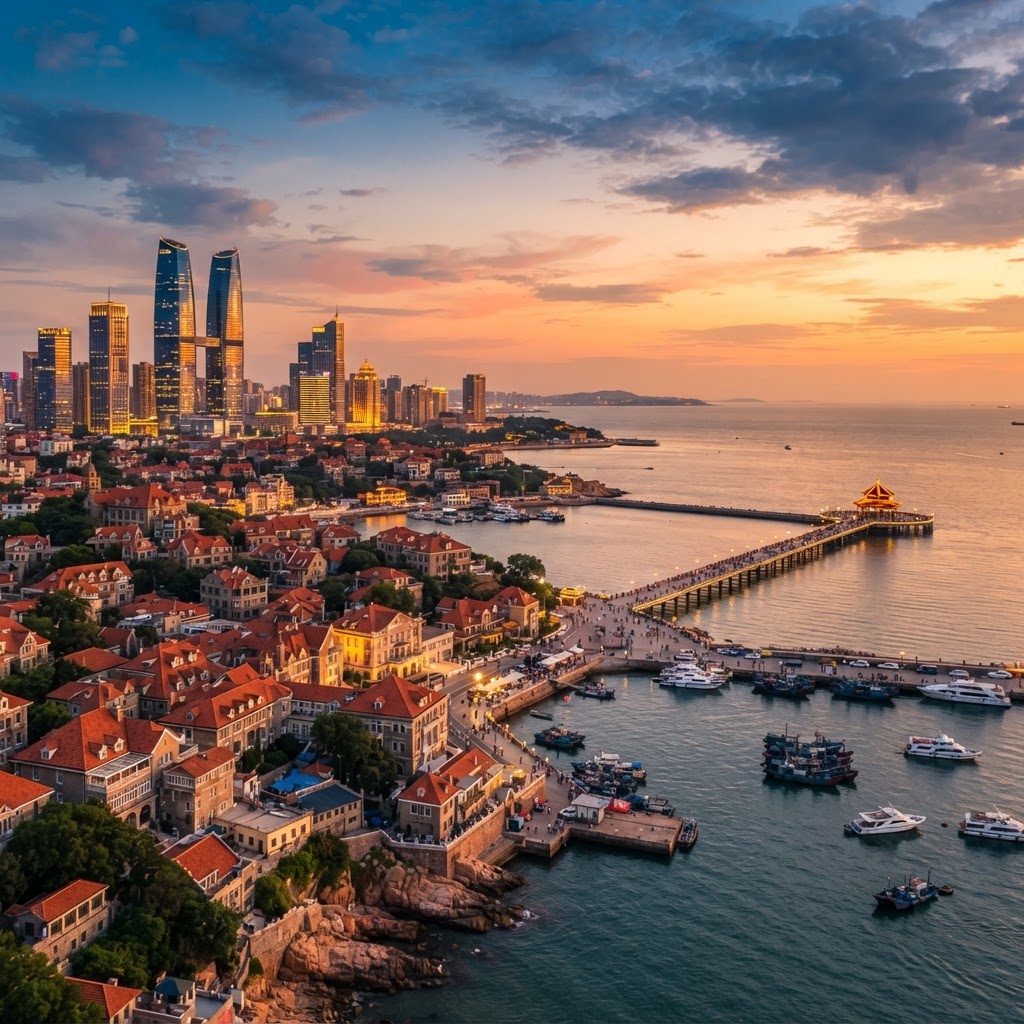
Qingdao
Qingdao is a coastal city in Shandong and one of China's most attractive — a seaside port famous for German colonial architecture, red-tiled villas, its namesake beer and a relaxed maritime lifestyle. It is a major hub for marine science, home appliances (Haier, Hisense) and rail-equipment (CRRC). Ocean University of China and Shandong University (Qingdao) anchor its academic base. For students it offers sea breezes, mild summers, lower costs than the Tier 1 megacities and a distinctive European-flavoured seaside identity.
Why students choose Qingdao
Qingdao's student life is seaside and relaxed: the Badaguan villa district, Zhanqiao Pier, May Fourth Square, beaches at Golden Sand, the Tsingtao Beer Museum, sailing (Qingdao hosted the 2008 Olympic sailing events), and seafood markets. Ocean University of China's campus is near the sea. The international community is modest but warm; the city is a popular long-term expat choice for its livability.
Career & jobs: Qingdao is a leader in home appliances (Haier, Hisense HQ), rail equipment (CRRC Sifang), marine science and biotechnology, plus a major port and trade economy. Internships in manufacturing, trade, marine science and supply chain are accessible. The job market is smaller than the Tier 1 cities but strong in its specialisms; graduates are recruited across northern China, and the city's livability retains talent.
What you need to know about Qingdao
$450/mo
Qingdao is a leader in home appliances (Haier, Hisense HQ), rail equipment (CRRC Sifang), marine science and biotechnology, plus a major port and trade economy. Internships in manufacturing, trade, marine science and supply chain are accessible. The job market is smaller than the Tier 1 cities but strong in its specialisms; graduates are recruited across northern China, and the city's livability retains talent.
Qingdao is safe, clean and orderly — a relaxed seaside city with low crime and a comfortable pace. Summer brings sea fog and occasional typhoons; otherwise the city is one of the most liveable in northern China. Standard urban precautions suffice; the city is very welcoming to international residents.
Qingdao's metro is expanding across the bays and to the airport and high-speed-rail hub — Beijing in 3 hours, Shanghai in 5 hours. Jiaodong International Airport serves domestic and regional routes. The city's hilly, coastal layout makes cycling limited; buses, metro and ride-hailing dominate. Ferries and bridges connect the mainland to the bay districts.
Qingdao cuisine is seafood-led and Shandong-style: clams, sea cucumber, roasted meats, jiaozi dumplings, and the famous fresh Tsingtao beer drunk with seafood. The city's German heritage adds sausages and beer culture; seafood streets near the port serve fresh catches at reasonable prices. Food is hearty, salty-savoury northern fare with a strong street-barbecue culture, especially in summer with beer in plastic bags — a local tradition.
Zhanqiao Pier, Badaguan, May Fourth Square, Tsingtao Beer Museum, Mount Lao, Golden Sand Beach, St. Michael's Cathedral
Universities in Qingdao
No universities listed yet — ask an advisor for the full list.
Fund your studies in Qingdao
These scholarships apply to students heading to Qingdao. Check eligibility and apply early.
Guangdong Government Scholarship
Full tuition + stipend + insurance
PartialUniversityFudan University Scholarship
Full tuition + accommodation + stipend + insurance
Fully FundedEnterpriseTencent Scholarship
Partial tuition + internship stipend
PartialUniversityWuhan University Scholarship
Full tuition + accommodation + stipend + insurance
Fully FundedStudent visa for Qingdao
- X1 visa — long-term (degree programs, valid for the full study period)
- X2 visa — short-term (language and exchange programs up to 180 days)
- JW202 form from your university + admission notice required
- Convert to a residence permit within 30 days of arrival at the local Qingdao Entry-Exit Bureau
How to apply in Qingdao
- 1. Choose a university and program in Qingdao
- 2. Prepare documents (passport, transcripts, recommendation letters, study plan)
- 3. Submit the application and pay any application fee
- 4. Receive admission notice and JW202 form
- 5. Apply for your student visa at the Chinese embassy
- 6. Travel to Qingdao and register at your university
Applications for September intake usually close in June; spring intake closes in December.: Applications for September intake usually close in June; spring intake closes in December.
Most universities require a high school diploma (Bachelor), a relevant Bachelor (Master), language proficiency (HSK or IELTS), and a valid passport: Most universities require a high school diploma (Bachelor), a relevant Bachelor (Master), language proficiency (HSK or IELTS), and a valid passport.
Partner with us in Qingdao
Universities and agencies in Qingdao can partner with StudyInChina to recruit international students.