
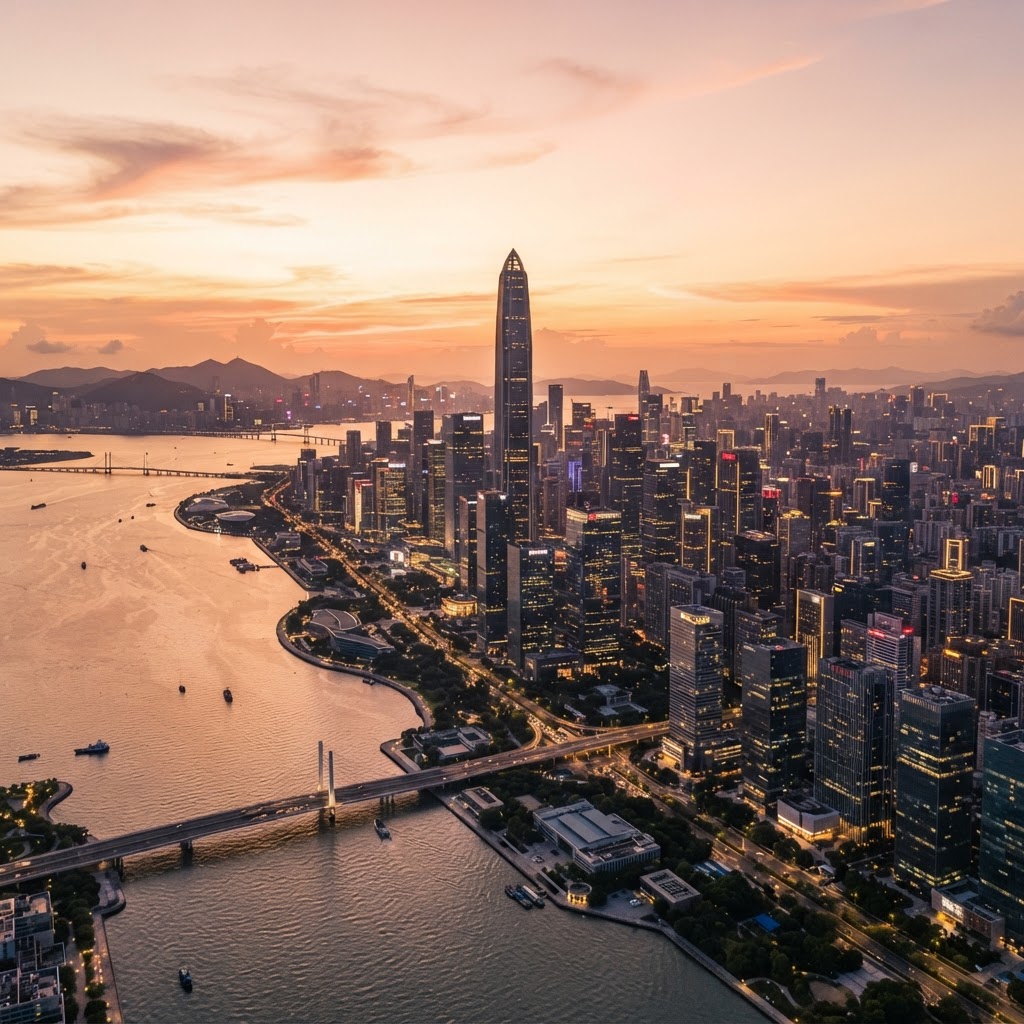
Shenzhen
China's Silicon Valley, Shenzhen grew from a fishing village to a 17-million metropolis in 40 years and is now the global capital of hardware, electronics and consumer-tech innovation. Bordering Hong Kong, it is young, fast and immigrant-built — the average resident is 32. For students it offers a unique window into China's tech engine, proximity to global finance via HK, a relaxed coastal climate, and the most startup-dense ecosystem in the country around Nanshan and Bao'an.
Why students choose Shenzhen
Shenzhen's student scene is young and entrepreneurial: co-working spaces in Nanshan, hardware markets at Huaqiangbei, maker faires, English-speaking expat sports leagues, beach weekends at Dameisha, hikes in Wutong Mountain, and a constant churn of startup meetups. The city's youth means nightlife and café culture lean modern and international, especially around OCT Loft and Coastal City.
Career & jobs: The strongest tech job market in China: Tencent, DJI, BYD, Huawei (Dongguan-adjacent), Honor, OnePlus, Anker and thousands of hardware startups cluster here. Engineering, product, supply-chain and export-trading internships are abundant; English speakers find roles in cross-border e-commerce (Amazon/Shopee sellers). Graduates can apply for a Shenzhen hukou with relatively low thresholds, attracting young talent nationally.
What you need to know about Shenzhen
$680/mo
The strongest tech job market in China: Tencent, DJI, BYD, Huawei (Dongguan-adjacent), Honor, OnePlus, Anker and thousands of hardware startups cluster here. Engineering, product, supply-chain and export-trading internships are abundant; English speakers find roles in cross-border e-commerce (Amazon/Shopee sellers). Graduates can apply for a Shenzhen hukou with relatively low thresholds, attracting young talent nationally.
As one of China's newest and wealthiest cities, Shenzhen is extremely safe, clean and orderly. Crime is negligible, streets are well-lit, and the border areas with Hong Kong are heavily managed. The main hazard is summer typhoons and the fast pace of road traffic near industrial zones.
Shenzhen's metro is modern and expanding rapidly across 16+ lines, connecting directly into Hong Kong's MTR at Lo Wu and Lok Ma Chau. High-speed rail reaches Guangzhou in 30 minutes. Buses and shared bikes fill gaps, ride-hailing (Didi) is cheap, and Bao'an International Airport serves domestic and growing long-haul routes. A student transport pass keeps the metro very affordable.
Cantonese dominates — dim sum, roast goose, seafood hotpot, congee — but Shenzhen's migrant population means every regional Chinese cuisine is well represented, plus strong Korean, Japanese and Western options around Nanshan. Late-night food streets and 24-hour Cantonese noodle shops feed the city's round-the-clock work culture.
Huaqiangbei Electronics Market, Window of the World, Dameisha Beach, OCT Loft, Lianhua Mountain, Dafen Oil Painting Village, Ping An Finance Centre
Universities in Shenzhen
Fund your studies in Shenzhen
These scholarships apply to students heading to Shenzhen. Check eligibility and apply early.
Guangdong Government Scholarship
Full tuition + stipend + insurance
PartialUniversityFudan University Scholarship
Full tuition + accommodation + stipend + insurance
Fully FundedEnterpriseTencent Scholarship
Partial tuition + internship stipend
PartialUniversityWuhan University Scholarship
Full tuition + accommodation + stipend + insurance
Fully FundedStudent visa for Shenzhen
- X1 visa — long-term (degree programs, valid for the full study period)
- X2 visa — short-term (language and exchange programs up to 180 days)
- JW202 form from your university + admission notice required
- Convert to a residence permit within 30 days of arrival at the local Shenzhen Entry-Exit Bureau
How to apply in Shenzhen
- 1. Choose a university and program in Shenzhen
- 2. Prepare documents (passport, transcripts, recommendation letters, study plan)
- 3. Submit the application and pay any application fee
- 4. Receive admission notice and JW202 form
- 5. Apply for your student visa at the Chinese embassy
- 6. Travel to Shenzhen and register at your university
Applications for September intake usually close in June; spring intake closes in December.: Applications for September intake usually close in June; spring intake closes in December.
Most universities require a high school diploma (Bachelor), a relevant Bachelor (Master), language proficiency (HSK or IELTS), and a valid passport: Most universities require a high school diploma (Bachelor), a relevant Bachelor (Master), language proficiency (HSK or IELTS), and a valid passport.
Partner with us in Shenzhen
Universities and agencies in Shenzhen can partner with StudyInChina to recruit international students.