
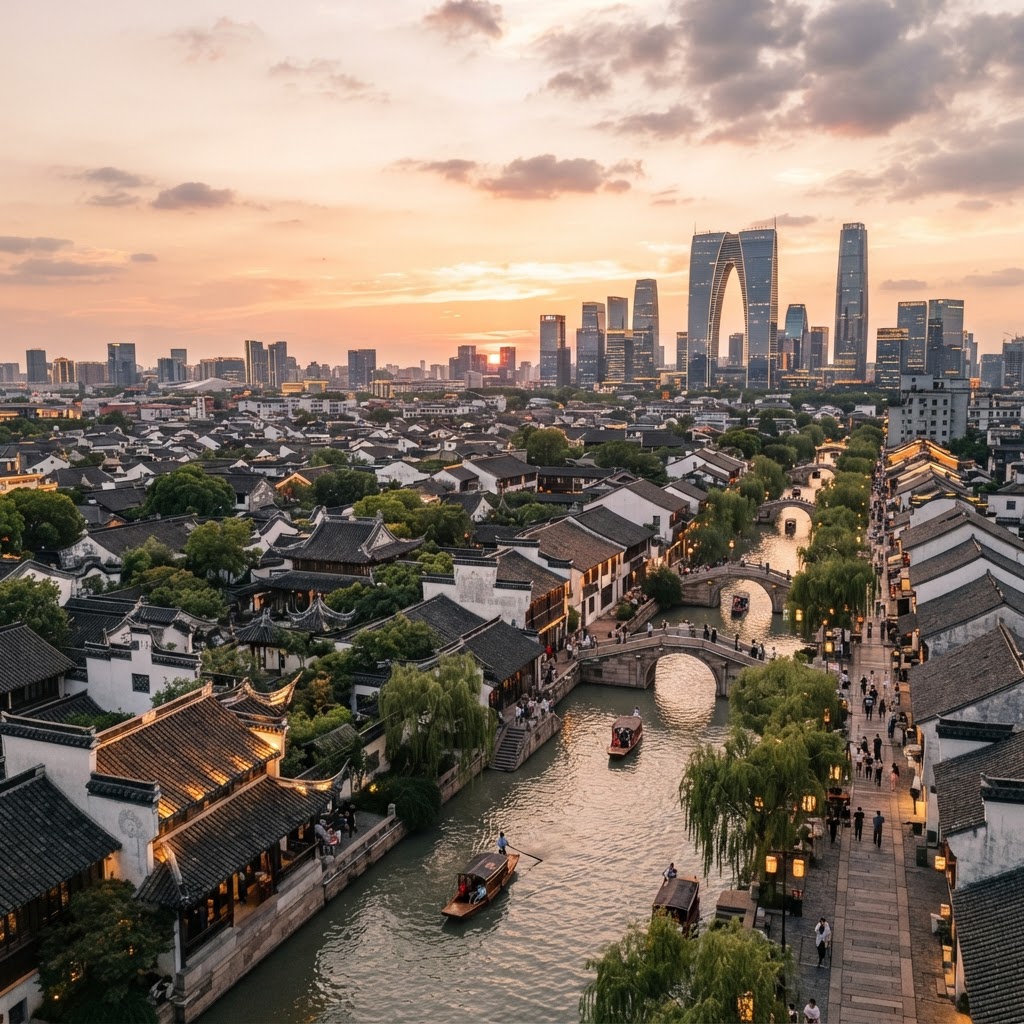
Suzhou
Suzhou is famed as the 'Venice of the East' — a 2,500-year-old water town of classical gardens, canals and silk, now also one of China's richest cities and a global high-tech manufacturing powerhouse via the Singapore-built Suzhou Industrial Park (SIP). It sits beside Shanghai (25 min by high-speed rail). Soochow University and Xi'an Jiaotong–Liverpool University (XJTLU, an English-medium Sino-foreign campus) anchor its academic base. For students it offers classical beauty, a strong international campus at XJTLU, and deep proximity to Shanghai's job market.
Why students choose Suzhou
Suzhou's student life blends classical Chinese beauty and modern comfort: the Humble Administrator's Garden, Pingjiang canal road, tiger-hill pagoda, Suzhou Museum (I.M. Pei), silk factories, Jinji Lake evenings in SIP, and Shanghai weekends. XJTLU's English-medium campus draws a large international cohort; Soochow University has a strong local scene. The pace is refined and liveable — quieter than Shanghai but a short hop away.
Career & jobs: Suzhou is a global high-tech manufacturing leader (semiconductors, biotech, electronics in SIP and SND), with many Fortune 500 operations and a strong biotech cluster at BioBay. Internships in manufacturing, biotech, supply chain and trade are plentiful; the Shanghai proximity doubles the accessible job market. English-language roles exist at multinationals and the Sino-foreign campuses. The city actively retains graduates with housing incentives.
What you need to know about Suzhou
$520/mo
Suzhou is a global high-tech manufacturing leader (semiconductors, biotech, electronics in SIP and SND), with many Fortune 500 operations and a strong biotech cluster at BioBay. Internships in manufacturing, biotech, supply chain and trade are plentiful; the Shanghai proximity doubles the accessible job market. English-language roles exist at multinationals and the Sino-foreign campuses. The city actively retains graduates with housing incentives.
Suzhou is exceptionally safe, clean and orderly — one of China's wealthiest and best-managed cities. Crime is negligible, streets are quiet at night, and the city is comfortable for international students. The main note is high summer humidity; otherwise it is a model of urban liveability.
Suzhou's metro is modern and expanding across the old city, SIP and the new district, connecting to the high-speed-rail stations — Shanghai in 25 minutes. The city is a regional rail and expressway hub; buses, shared bikes and ride-hailing are cheap. The old canal city is walkable; SIP is bike- and metro-friendly. Transit costs are moderate and student passes are available.
Suzhou cuisine is delicate Jiangsu fare: sweet squirrel mandarin fish, songshu gui-yu, Biluochun tea shrimp, mooncakes, sweet glutinous-rice desserts and soup dumplings. The dining scene is refined and slightly sweet; international options are strong in SIP near XJTLU. Prices are higher than inland cities but the quality is excellent; the café and dessert culture is a local pride.
Humble Administrator's Garden, Pingjiang Road, Tiger Hill, Suzhou Museum, Jinji Lake, Lingering Garden, Shantang Street
Universities in Suzhou
No universities listed yet — ask an advisor for the full list.
Fund your studies in Suzhou
These scholarships apply to students heading to Suzhou. Check eligibility and apply early.
Guangdong Government Scholarship
Full tuition + stipend + insurance
PartialUniversityFudan University Scholarship
Full tuition + accommodation + stipend + insurance
Fully FundedEnterpriseTencent Scholarship
Partial tuition + internship stipend
PartialUniversityWuhan University Scholarship
Full tuition + accommodation + stipend + insurance
Fully FundedStudent visa for Suzhou
- X1 visa — long-term (degree programs, valid for the full study period)
- X2 visa — short-term (language and exchange programs up to 180 days)
- JW202 form from your university + admission notice required
- Convert to a residence permit within 30 days of arrival at the local Suzhou Entry-Exit Bureau
How to apply in Suzhou
- 1. Choose a university and program in Suzhou
- 2. Prepare documents (passport, transcripts, recommendation letters, study plan)
- 3. Submit the application and pay any application fee
- 4. Receive admission notice and JW202 form
- 5. Apply for your student visa at the Chinese embassy
- 6. Travel to Suzhou and register at your university
Applications for September intake usually close in June; spring intake closes in December.: Applications for September intake usually close in June; spring intake closes in December.
Most universities require a high school diploma (Bachelor), a relevant Bachelor (Master), language proficiency (HSK or IELTS), and a valid passport: Most universities require a high school diploma (Bachelor), a relevant Bachelor (Master), language proficiency (HSK or IELTS), and a valid passport.
Partner with us in Suzhou
Universities and agencies in Suzhou can partner with StudyInChina to recruit international students.