
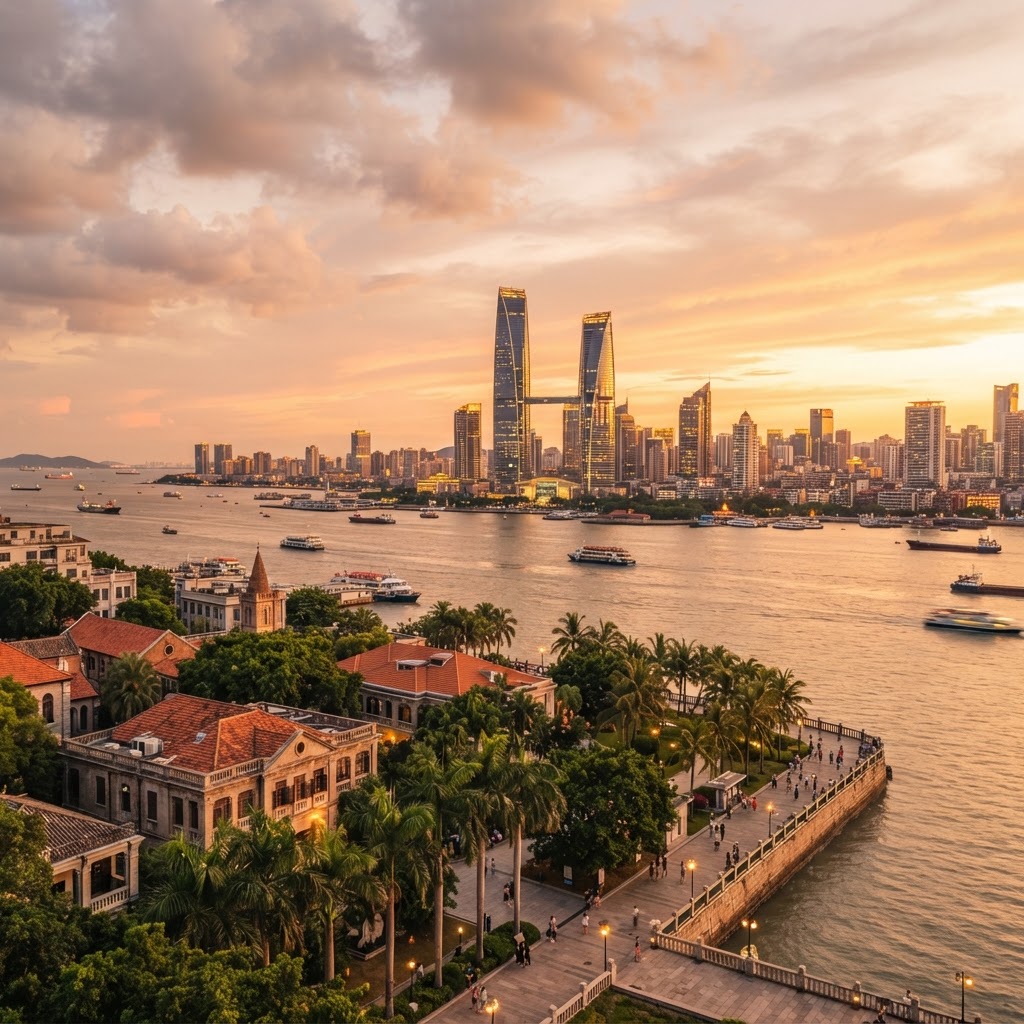
Xiamen
Xiamen is a coastal city in Fujian and one of China's most liveable and beautiful — a clean, green, subtropical island-city facing Taiwan, famous for the car-free Gulangyu Island with its colonial piano-museum architecture. Xiamen University is one of China's most scenic campuses, set on the sea. For students it offers a relaxed seaside lifestyle, mild winters, strong Southeast Asian trade ties, and a smaller, friendlier international community than the megacities.
Why students choose Xiamen
Xiamen's student life is seaside and relaxed: cycling the island ring road, Gulangyu day trips, beach barbecues, the Zhongshan Road food street, Nanputuo Temple next to the campus, tea culture, and a slow pace unusual for a major Chinese city. Xiamen University's coastal campus is widely considered China's most beautiful. The international community is small but tight-knit, and the city's livability attracts long-term foreign residents.
Career & jobs: Xiamen leads in international trade, logistics, tourism, optics and biotech, with strong Southeast Asian business ties. Internships in export trade, logistics, tourism and hospitality are accessible; the city hosts many cross-border e-commerce firms. The job market is smaller than the megacities but high-quality; English-language roles cluster in trade and hospitality. Xiamen University graduates are well-regarded across Fujian and the Greater Bay Area.
What you need to know about Xiamen
$550/mo
Xiamen leads in international trade, logistics, tourism, optics and biotech, with strong Southeast Asian business ties. Internships in export trade, logistics, tourism and hospitality are accessible; the city hosts many cross-border e-commerce firms. The job market is smaller than the megacities but high-quality; English-language roles cluster in trade and hospitality. Xiamen University graduates are well-regarded across Fujian and the Greater Bay Area.
Xiamen is exceptionally safe, clean and orderly — among China's most liveable cities. Crime is very low, the seafront stays busy and safe, and the pace is calm. The main environmental note is summer typhoons, which occasionally disrupt transport for a day or two.
Xiamen has a modern metro connecting the island to the mainland and to Xiamen Gaoqi International Airport; a new airport is under construction. High-speed rail links to Shenzhen in 3 hours and Shanghai in 5 hours. The city is compact and walkable along the seaside, with ferries to Gulangyu. Ride-hailing and shared bikes handle daily needs; transport costs are moderate.
Xiamen (Minnan) cuisine is delicate and seafood-led: oyster omelette, satay noodles, peanut soup, spring rolls, shrimp noodles, and fresh seafood. The city's tea culture is strong (tieguanyin oolong). International dining is decent around the university and Siming district. Food is less spicy than Sichuan and more subtle and coastal; the seafood is a highlight.
Gulangyu Island, Xiamen University campus, Nanputuo Temple, Zhongshan Road, Zengcuo'an Village, Hulishan Fortress, Bathing Beach
Universities in Xiamen
No universities listed yet — ask an advisor for the full list.
Fund your studies in Xiamen
These scholarships apply to students heading to Xiamen. Check eligibility and apply early.
Guangdong Government Scholarship
Full tuition + stipend + insurance
PartialUniversityFudan University Scholarship
Full tuition + accommodation + stipend + insurance
Fully FundedEnterpriseTencent Scholarship
Partial tuition + internship stipend
PartialUniversityWuhan University Scholarship
Full tuition + accommodation + stipend + insurance
Fully FundedStudent visa for Xiamen
- X1 visa — long-term (degree programs, valid for the full study period)
- X2 visa — short-term (language and exchange programs up to 180 days)
- JW202 form from your university + admission notice required
- Convert to a residence permit within 30 days of arrival at the local Xiamen Entry-Exit Bureau
How to apply in Xiamen
- 1. Choose a university and program in Xiamen
- 2. Prepare documents (passport, transcripts, recommendation letters, study plan)
- 3. Submit the application and pay any application fee
- 4. Receive admission notice and JW202 form
- 5. Apply for your student visa at the Chinese embassy
- 6. Travel to Xiamen and register at your university
Applications for September intake usually close in June; spring intake closes in December.: Applications for September intake usually close in June; spring intake closes in December.
Most universities require a high school diploma (Bachelor), a relevant Bachelor (Master), language proficiency (HSK or IELTS), and a valid passport: Most universities require a high school diploma (Bachelor), a relevant Bachelor (Master), language proficiency (HSK or IELTS), and a valid passport.
Partner with us in Xiamen
Universities and agencies in Xiamen can partner with StudyInChina to recruit international students.